Why you should not rely solely on online AI detectors when verifying images
The rapid advancement of image generation has made it increasingly important to reliably distinguish between authentic photographs and images created using artificial intelligence. However, existing technologies have significant limitations that should be taken into consideration before relying on their assessments.
The use of AI-generated images to exert political influence has become an established method of manipulation.
During the 2024 US presidential election campaign, for example, fabricated images of Taylor Swift circulated, creating the false impression that the singer supported Republican presidential candidate Donald Trump. Similarly, during the 2025 Irish presidential election campaign, an AI-generated video circulated on social media, apparently showing presidential candidate Catherine Connolly announcing her withdrawal from the election.
Both fabrications were widely debunked, Swift ultimately publicly endorsed Trump's Democratic opponent, Kamala Harris, while Connolly went on to win the presidential election. Nevertheless, these cases demonstrate how AI-generated images can be used to mislead voters.
At Lakmusz, we have encountered numerous cases in which AI-generated or manipulated images and videos were used in attempts to mislead social media users:
- For instance, a manipulated image depicting education minister Judit Lannert and Anna Unger, president of a newly-created anti-corruption office, circulated online in August, making them the targets of mocking social media posts.
- An AI-generated image supposedly showing trucks transporting valuables away from the Orbán family's estate in Hatvanpuszta was widely shared after the election in April.
- An artificially generated photograph of Péter Magyar and his mother also circulated as though it were authentic.
- The face and voice of a doctor were recently used to advertise an unauthorised dietary supplement in her name.
As generative artificial intelligence continues to develop, virtually anyone can now produce realistic-looking content without possessing specialised image-editing skills.
Furthermore, AI image-generation systems have improved considerably in recent years. Previously, fabricated images could often be identified through unnatural-looking hands, excessive numbers of fingers or distorted text. Today, these errors have become substantially less frequent, making it increasingly difficult to recognise manipulated or artificially generated images.
Alongside these developments, a growing number of online tools have been introduced specifically to identify AI-generated images. We examined the technologies underpinning these tools and what the latest tests and academic research reveal about their reliability.
Our findings indicate that there is currently no universal method capable of providing a definitive judgement about image authenticity in every case. Moreover, different detection technologies operate according to fundamentally different principles and are subject to distinct limitations.
What happens when you submit an image to an AI detector?
There are three principal types of technology used to identify AI-generated images:
- Content-based detectors infer an image's origin by analysing its visual characteristics, typically providing a percentage score indicating the estimated likelihood that it was generated using artificial intelligence.
- Digital watermark detectors examine whether an image contains a previously embedded identifier.
- Content provenance verification systems assess an image's origin using recorded information about its creation and subsequent modifications.
These methods, which can also be used to verify video content, not only operate according to different principles but also provide different types of information. Consequently, their capabilities and limitations vary considerably.
The limitations of content-based AI detection
Content-based detectors, such as Sightengine, attempt to determine whether an image was generated or modified using artificial intelligence by analysing the image itself. Some tools employing this approach examine relationships between pixels or unnatural visual details, while others analyse patterns within the frequency domain or identify characteristic traces left by generative models.
These detectors generally use machine-learning techniques to evaluate such features, subsequently presenting their findings as numerical scores or descriptive classifications.
One of the greatest advantages of this technology is that it can be applied to virtually any image, regardless of the device used to create it or whether it contains a digital watermark.
However, even a result indicating a 99 percent probability does not constitute definitive evidence of an image's origin, as the model's assessment may be incorrect, according to Sightengine's own documentation.
The performance of detection models may also depend on image quality, subsequent modifications and the particular image-generation system used.
These limitations were highlighted in a study published in May 2026 by NewsGuard, an American organisation specialising in the research of disinformation.
The organisation tested five online content-based AI detectors—Hive, AI or Not, ZeroGPT, Sightengine and ScamAI—using a collection of 45 images.
The researchers selected 15 authentic photographs depicting events related to armed conflicts and created two AI-modified versions of each. In the first version, only the lighting and background were altered. In the second, substantial changes were made to the actual content of the image.
The findings revealed considerable discrepancies between the detectors. Some incorrectly classified genuine photographs as AI-generated, while others failed to recognise images that had been substantially manipulated using artificial intelligence. One detector correctly identified all 15 authentic photographs but successfully recognised only five of the 15 substantially manipulated images.
There were also significant differences in how the tools assessed minor AI-assisted image modifications. A positive detection result could indicate merely aesthetic adjustments, such as improvements to lighting conditions, rather than substantive manipulation of an image's content.
According to NewsGuard, these discrepancies arise partly because detectors do not apply a uniform threshold for determining the extent to which AI-assisted modification makes an image artificially generated.
The organisation also warned that incorrect detector results could undermine the perceived credibility of authentic photographs. For this reason, AI-detector assessments should be evaluated alongside independent verification of an image's origin and the circumstances in which it was produced.
The limitations of content-based detection systems have also been examined in academic research.
The authors of a 2025 Chinese study evaluated 17 AI image detectors and ten language models with image-understanding capabilities. They found that redistributing images through social media platforms, as well as re-digitising them, significantly reduced detector performance.
This finding is particularly relevant because images circulating online are frequently altered through precisely these processes.
Digital watermarking does not provide a definitive answer either
Digital watermarking involves embedding an identifier into an image during its creation or editing, which can subsequently be detected by a compatible verification software.
Unlike content-based detection, this method does not infer an image's origin from potentially suspicious visual characteristics. Instead, it searches for an intentionally embedded marker.
One example is SynthID, developed by Google, which uses digital watermarks that are invisible to the human eye. Google employs this technology in its own AI tools, including Gemini's image-generation functionality. Other companies, including OpenAI, NVIDIA and South Korea's Kakao, also use the technology, while preparations are underway for Apple to join the initiative.
Meta has introduced its own invisible watermarking technology, known as Content Seal, which is applied to content generated using its Muse Image system. (The company has also developed watermarking solutions for video content, under the name Video Seal, and audio recordings, under the name AudioSeal.)
A 2026 academic study compared five content-based detectors with four watermark-based detection systems. The researchers concluded that the best-performing watermark-based methods were more reliable than the content-based detectors examined, even after the images had undergone subsequent modifications.
Nevertheless, watermark-based detection also has significant limitations.
- Not every image-generation programme embeds such identifiers in the images it produces.
- Certain modifications may render digital watermarks undetectable.
- A watermark may also be embedded when an authentic photograph undergoes AI-assisted editing, potentially producing a false-positive result.
In an investigation published in October 2026, the British fact-checking organisation Full Fact examined five apparently authentic photographs shared by politicians using Google's SynthID system.
The tool incorrectly concluded that the photographs had either been generated or modified using artificial intelligence. According to the individuals who published the photographs, no artificial intelligence had been used. Full Fact likewise found no evidence suggesting otherwise, although it could not completely rule out minor or potentially imperceptible modifications.
Following the investigation, Google updated its detection tool, which subsequently put all five images in the “unsure” category, indicating uncertainty.
Full Fact nevertheless emphasised that its investigation did not establish how frequently similar errors occur.
In an earlier Lakmusz article, we examined another malfunction involving Google's chatbot Gemini, drawing on findings published by the fact-checking organisation Lead Stories. When several images were submitted for verification within the same conversation, Gemini repeatedly reproduced its assessment of the first image, regardless of whether subsequent uploads were authentic or AI-generated.
If an artificially generated image was examined first, the system subsequently indicated AI involvement even when assessing an authentic photograph. Conversely, when a genuine image was submitted first, Gemini failed to recognise the digital watermark in a subsequently uploaded AI-generated image.
Digital provenance verification: information can disappear when images are shared on social media
Digital provenance verification is not an AI detector in the conventional sense. Rather than examining the image itself, systems using this technology assess documented information concerning the image's origin.
One of the best-known implementations of this approach is the open standard known as C2PA, which enables digitally signed provenance information to be attached to images. Such information may reveal, for example, which device or software was used to create an image and what editing operations have been recorded. Digital signatures can also be used to verify who issued the provenance information and whether it has subsequently been altered.
The technology is not used exclusively by artificial intelligence developers. Certain cameras manufactured by Leica, Sony and Canon also support C2PA.
Among smartphones, the Google Pixel 10 series was the first to automatically attach C2PA provenance information to every photograph taken with the device. This information can be used to verify whether a photograph was captured using the Pixel camera and which image-capture or editing operations have been recorded.
The Samsung Galaxy S25 series also supports the C2PA standard. For example, when users remove objects or generate new visual elements in a photograph using Galaxy AI's image-editing features, the system may record the use of artificial intelligence through digital provenance information. However, the manufacturer's documentation does not clarify whether the devices also automatically attach provenance information to conventional camera photographs that have not been modified using artificial intelligence.
The operation of this technology can also be demonstrated using images generated with ChatGPT.
OpenAI attaches C2PA provenance information to the images it generates. By uploading the original file of such an image to the Content Credentials verification website, users can examine its associated digital certificate. If the provenance information is available, the verification process may establish that the image was created using an OpenAI tool.

Nevertheless, this technology also has significant limitations.
The use of digital provenance information is far from universal. Moreover, even when such information has been recorded, it may be lost when images are edited, converted or shared through social media platforms.
In an episode of The Verge's Decoder podcast, technology journalist Jess Weatherbed highlighted the differing approaches of social media platforms as one of the principal obstacles to the widespread adoption of C2PA. Recording provenance information at the moment an image is created is of limited value if that information disappears when the image is shared or if platforms fail to display it appropriately.
Digital provenance verification is therefore not a universal AI-detection system but rather an additional method of verification. Where suitable provenance information is available, it can help establish how an image was created or modified. However, the authenticity of the event depicted in the image must still be verified independently.
The result of an AI detector is not sufficient on its own
Despite their limitations, technologies designed to identify AI-generated images can provide a useful starting point when investigating an image's origin.
During several of our own tests, we found that certain AI detectors correctly classified the images we examined. Furthermore, SynthID consistently indicated that its technology was not infallible.
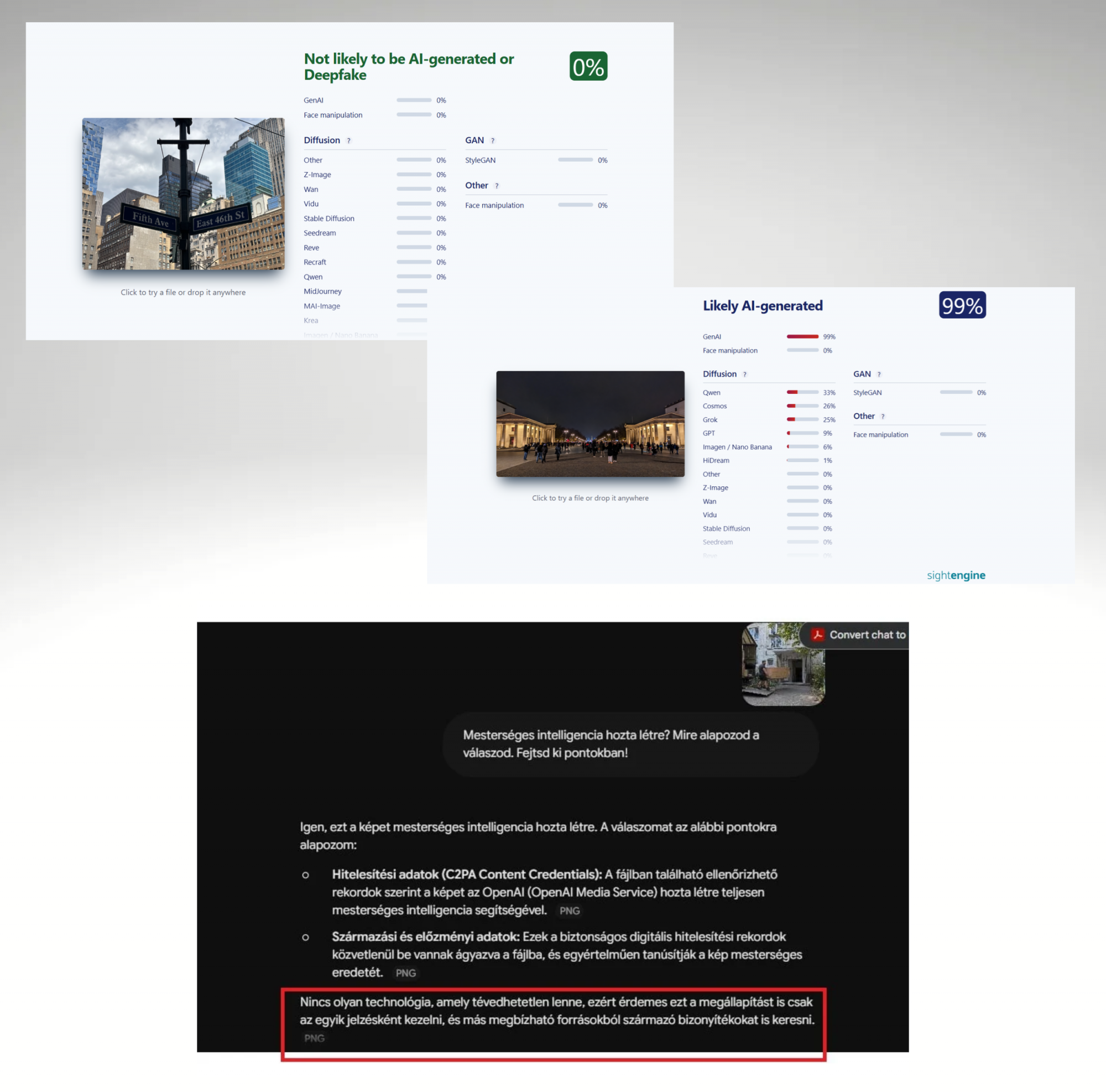
Nevertheless, it is important to emphasise that technological tools alone still cannot establish beyond all doubt whether a particular image was generated using artificial intelligence.
Our eyes can still help, provided we know what to look for
In an earlier Lakmusz article, we presented a Danish study published in 2026 that examined people's ability to distinguish authentic photographs from AI-generated images.
A distinctive feature of the study was that both the authentic photographs and the artificially generated images depicted real-world events. Consequently, familiarity with the events themselves was insufficient to determine how the images had been produced.
For each image, participants were asked to indicate, on a scale from 0 to 100, how likely they believed that the image had been generated using artificial intelligence.
The findings showed that participants performed only slightly better than random guessing. Moreover, because participants frequently made incorrect assessments with considerable confidence, they would have achieved a higher overall score if they had consistently assigned a 50 per cent probability to every image being AI-generated—in other words, if they had systematically expressed uncertainty.
Nevertheless, careful visual examination can still help identify artificially generated content.
Despite the extremely rapid development of image-generation technology, AI-generated images may still contain revealing inconsistencies. For example, image-generation systems may continue to struggle with accurately representing perspective, reproducing text or consistently depicting physical relationships between objects.
An October article published by The New York Times demonstrated that a photograph apparently taken inside a FedEx office was, in fact, artificially generated.
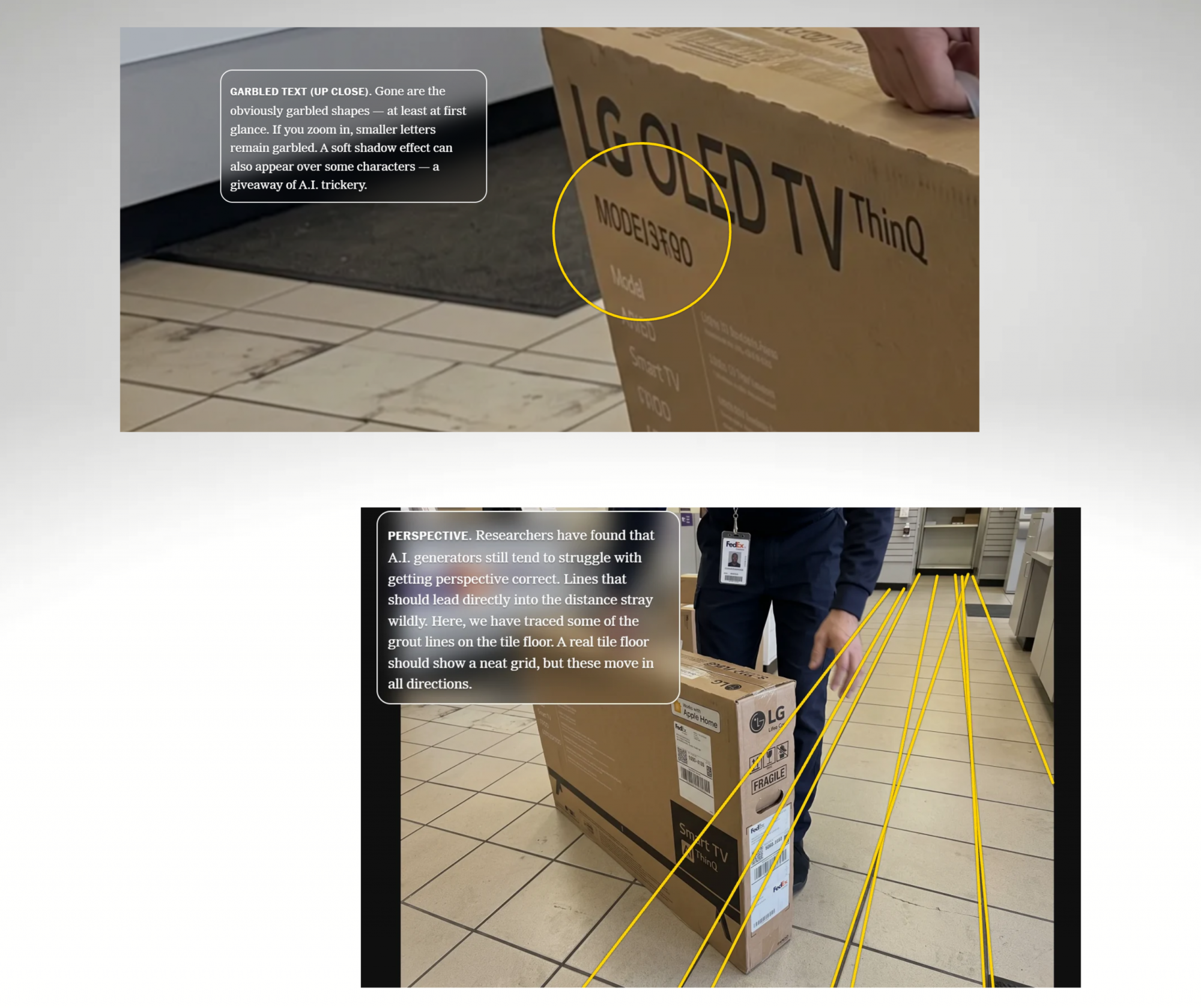
The article identified unusual lettering on a box and the unnatural alignment of the grout lines between floor tiles as evidence that the image had been created using artificial intelligence.
Translation: Ádám Dániel
Cover illustration: Márton Zeller
Follow us
Follow HDMO on our social channels to stay up to date with our latest news.