Despite Meta’s ban, Fidesz candidates successfully posted 162 political ads on Facebook in January
Fourteen Fidesz politicians circumvented Meta's ban on paid political advertising in January. Only a fraction of the ads was caught by the platform.
Although Meta stopped political advertising in the EU on October 6, the ruling party’s candidates for the parliamentary elections in April were able to run political ads on Facebook without interruption in January, a recent analysis by Political Capital found.
After reviewing Meta's ad library, Political Capital concluded that 14 of the 106 Fidesz candidates in constituencies successfully ran ads. Among them, the most active were:
- Zita Kelei (Somogy 2 electoral district): 39 ads
- Balázs Németh (Budapest 13): 37 ads
- Zsolt Papp (Hajdú-Bihar 6): 24 ads
- Botond Vántsa (Pest 10): 22 ads
According to Political Capital's calculations, as of January 25, the 14 Fidesz candidates had placed a total of 181 ads during the month. Of these, Meta classified only 19 as political, and these were eventually taken down after they went live.
In its analysis, Political Capital notes: "It is not always clear whether a Facebook ad is political in nature, but in the case of the pages of registered constituency candidates, there can be no question of political classification."
Advertising continues
We looked at what types of content the four most active Fidesz advertisers posted in order to circumvent Meta's rules. We also checked what kind of content the system caught. Meta does not specify how it determines whether a piece of content violates its internal rules, but in any case, there is no noticeable difference between the content that was removed and that which was allowed through.
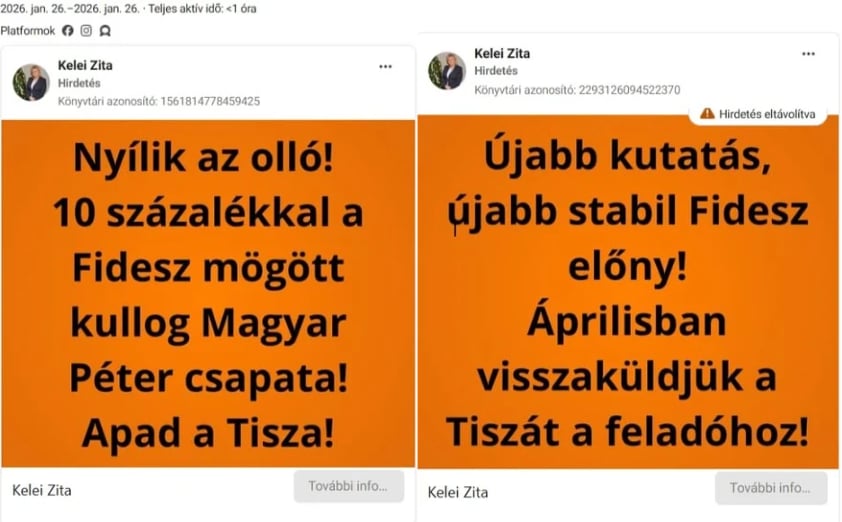
The biggest advertiser is Zita Kelei, who is running for office in the district Somogy 2 in April. Kelei had 39 paid ads, and according to our review, 31 of them reached Facebook users, while only 8 ads were stopped by the platform.
Kelei's most recent advertised post appeared on January 26, summarizing the results of a survey conducted by a Hungarian research institute called Magyar Társadalomkutató. A similar post published on January 20 also referred to the results of a poll predicting a Fidesz victory, but Meta identified it as a political advertisement and removed it.
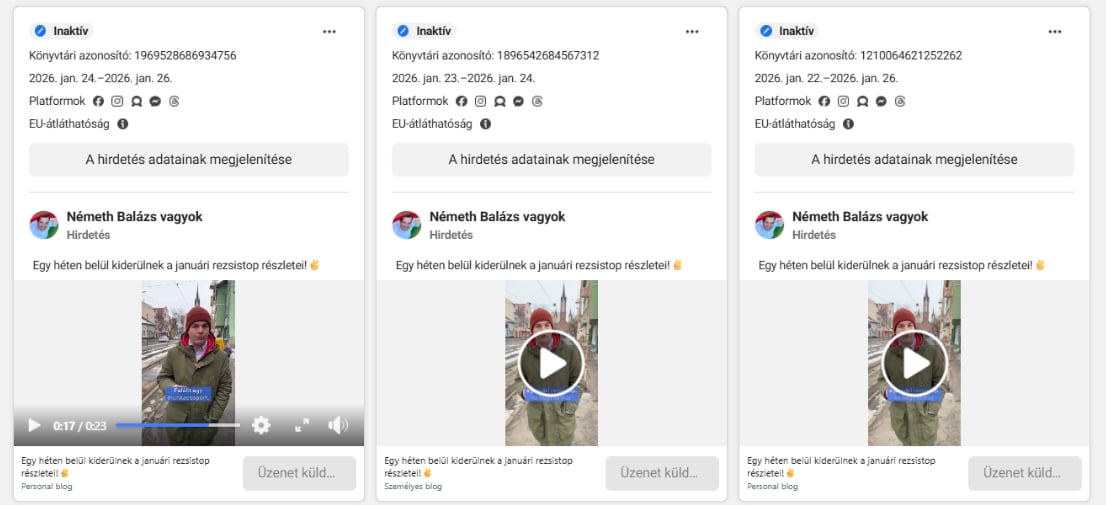
Balázs Németh posted 37 paid political ads between January 1 and 25. The ad library shows that he has posted one more since then, so a total of 32 of his ads have slipped through Meta's system in January, with only 6 of his posts being removed by the platform.
Balázs Németh is advertising the same content on multiple platforms and in multiple versions: he advertised his video about the January utility bill freeze in three versions on five Meta platforms.
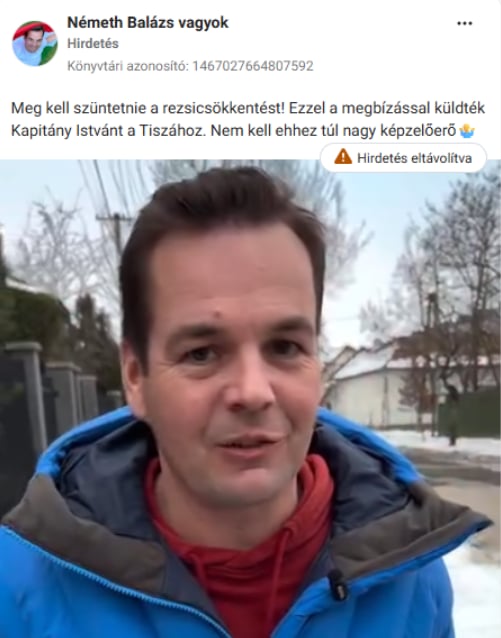
We only need to go back two days in time to see his most recent ad, which was removed by Meta. In the removed ad from January 24, Németh talks in a video about István Kapitány, who was recently introduced as the opposition Tisza Party's leading expert on economic development and energy.
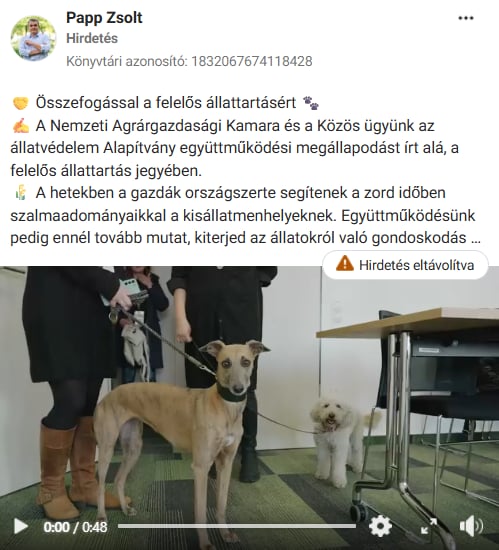
Zsolt Papp came third among Fidesz advertisers: he had 12 active paid posts until January 27, but not all of his posts are about party politics. Papp appears more often as president of the National Chamber of Agriculture than as a candidate in the advertised videos.
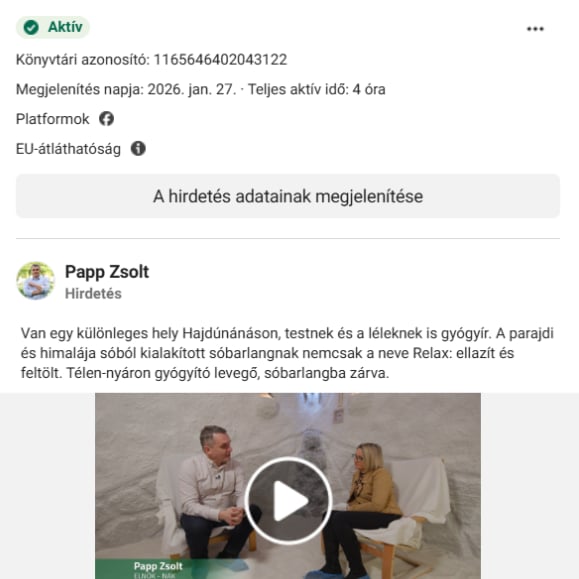
Political Capital identified 24 political advertisement on his account, and Papp has continued to advertise since then. In his most recent post, for example, he presented a salt cave made of Parajd and Himalayan salt, located in the Hungarian city of Hajdúnánás.
Prior to this, he promoted his own YouTube channel in Facebook ads, which features videos designed to build his image rather than party political messages.
His removed ads were like that: in the most recent video he presented the cooperation between the National Chamber of Agriculture and the Animal Protection Foundation.
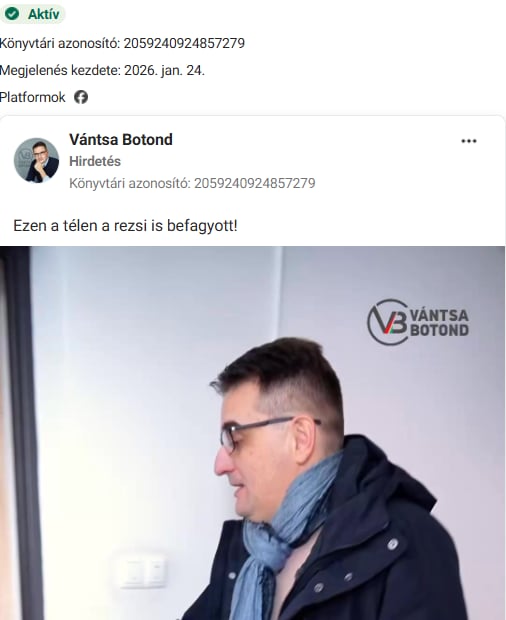
Political Capital found a total of 22 paid posts by Botond Vántsa that ran uninterrupted during the reviewed January period. On Tuesday, January 27, we found four active ads by him in the ad library.
In his most recent paid post, the Fidesz candidate talked about an event in Szigetszentmiklós, omitting party politics but mentioning his district at the end of the video, where he expects to receive votes in April. On January 24, in an advertised video, he talked—presumably with an elderly person living in his district—about how good the government's utility cost cap is. The paid ad was active at the time of publication of our article.
Opposition candidates are not advertising
According to data from Meta's ad library, the opposition Tisza Party’s candidates in the electoral districts of the most active Fidesz advirtisers have not placed a single paid advertisement on Facebook.
- In Somogy 2, Zita Kelei's challenger from the Tisza Party is József Benke. Benke is also quite active on Facebook, most recently drawing attention to the poor condition of side roads in his constituency, but he has never placed any paid ads on Meta.
- In Budapest's 13th district, Anna Müller is running against Balázs Németh under the banner of the Tisza Party. She also posts frequently on Facebook, but has had no political paid advertisements so far.
- Éva Göröghné Bocskai is challenging Fidesz candidate Zsolt Papp from the Tisza Party in Hajdú-Bihar county’s 6th district. She also frequently posts new content on her own Facebook page, but she has not yet paid for any ads either.
- Botond Vántsa's challenger is Andrea Kácsor. The Tisza candidate running in Pest 10 district commemorated the victims of the Holocaust on Facebook on January 27 but has never paid for any ads.
Violating the rules
In the case of certain political ads, Meta identifies rule violations after a certain period and then removes the advertisement – at which point it becomes visible how much money was spent on it. However, other ads are not removed, and in those cases, there is no chance to find out how much was spent on them.
The fact that political ads by Fidesz candidates, as well as videos with political content by the National Resistance Movement or Mandiner, were able to appear and remain on Facebook for varying lengths of time, may violate more than just Meta's internal rules. Since they are published without the information required by the EU regulation on the transparency of political advertisements, it may be argued that Meta and/or the advertiser are also violating EU regulations.
However, EU legislation has not yet been implemented in Hungary, which means that domestic laws should be enacted to designate a Hungarian authority (expected to be the National Media and Infocommunications Authority) that can enforce the transparency rules.
Even then, the process would not be simple. Under Irish law, Meta should be sanctioned by the Irish media authority, while under Hungarian law, the advertiser who placed the rule-breaking advertisement should be punished by the designated Hungarian authority.
(Cover photo: Márton Zeller)
Follow us
Follow HDMO on our social channels to stay up to date with our latest news.